
Publications

Excited to share our recent work published in【Chem Phys Lett】! 很開心分享最近發表於 Elsevier出版社旗下的【化學物理通訊】期刊!

Can a protein change its fluorescence without changing its structure?

Excited to share our latest work published in Chemical Physics Letters!

Tryptophan fluorescence is widely used to probe protein structure and dynamics. Yet the molecular origin of its temperature dependence remains an intriguing question.

Using bovine serum albumin (BSA) as a model system, we found that increasing temperature induces a subtle redistribution of Trp134 rotamer populations, even while the overall protein structure remains largely intact.

By combining molecular dynamics, free-energy landscape analysis, quantum chemistry, and QM/MM calculations, we reveal how small changes in local conformational stability can influence experimentally observable fluorescence.

Three key insights from our study:

• A protein does not need to unfold to exhibit a temperature-dependent fluorescence response.

• Subtle changes in free-energy landscapes can redistribute molecular populations and influence measurable physical properties.

• The protein environment matters: isolated molecular energetics do not necessarily capture the behavior of a chromophore embedded within a complex biomolecular environment.

For me, the broader significance lies in connecting molecular dynamics and statistical thermodynamics with experimental observables.

Rather than treating proteins as static structures, we view them as dynamic ensembles whose populations continuously evolve across complex energy landscapes.

Sometimes, a small molecular motion can tell a much bigger story.

Congratulations to I-Shan, Yun-Chu, and Wei-Hsiang for their contributions to this work!
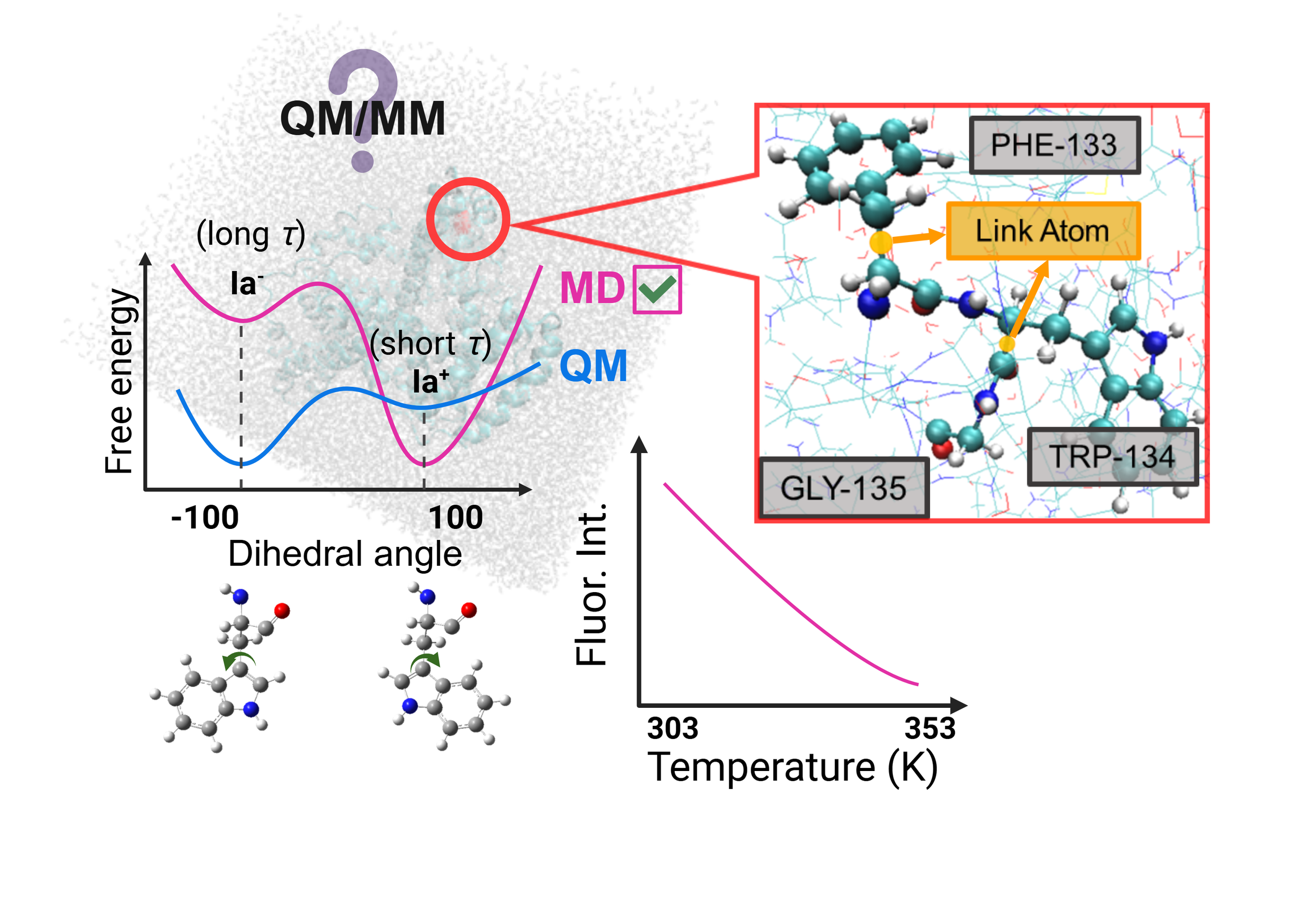
Temperature reshapes the rotamer free-energy landscape of Trp134, leading to population shifts that modulate intrinsic tryptophan fluorescence in proteins.


蛋白質沒有變形,螢光卻改變了?

很高興分享我們最新發表於 Chemical Physics Letters 的研究成果!

色胺酸(Tryptophan)螢光是研究蛋白質結構與動態的重要工具。然而,當溫度升高、螢光強度下降時,究竟是什麼分子機制造成這個變化?

我們以牛血清白蛋白(BSA)中的 Trp134 為研究對象,發現即使蛋白質整體結構維持穩定,色胺酸側鏈的旋轉異構物(Rotamers)仍會隨溫度升高而重新分布。

透過整合分子動力學(MD)、自由能地景分析、量子化學(QM)及 QM/MM 計算,我們從分子尺度建立構形動態與螢光訊號之間的物理連結。

這篇研究帶來三個重要啟示:

  1. 蛋白質不需要發生大規模結構變化,也能產生可量測的螢光響應。

  2. 自由能地景中的細微改變,可以透過分子構形族群的重新分配,影響實驗可觀測的物理性質。

  3. 分子所處的環境至關重要。孤立分子的能量特性,不一定能直接代表其在複雜蛋白質環境中的真實行為。

對我而言,這項研究更重要的意義,是如何將統計熱力學、分子動態與實驗觀測建立具有物理意義的連結。

我們不應只將蛋白質視為一個靜態的三維結構,而應將它理解為一個持續在複雜自由能地景中探索與重新分配的動態系綜。

有時候,一個微小的分子轉動,就能訴說一個更宏大的物理故事。

也恭喜苡珊、芸楚和葳翔,感謝大家在這項研究中的努力與貢獻!

📄 Temperature-dependent rotamer population shifts govern tryptophan fluorescence in proteins

Chemical Physics Letters 2026 899, 143025

https://doi.org/10.1016/j.cplett.2026.143025

Excited to Share Our Ground-breaking Computational Work Published in 【J Am Chem Soc】! 很高興與大家分享,我們突破性的計算研究成果已發表在【美國化學會會誌】期刊!

打磨多年,寶劍終於出鞘!

這項研究早在幾年前就有了初步成果,但在其他相關工作陸續發表的同時,它只能靜靜等待。

直到某天靈光乍現,找到最合適的敘事方式——『鎖』與『螺絲』的意象,讓這個研究得以完整呈現。

很開心它終於來到最棒的舞台,和大家見面!

蛋白質就像螺絲一樣在 DNA 上「鎖合」

我們最新的研究發現,Fis 蛋白質不只是黏在 DNA 上,而是能在不同 DNA 片段之間「跳躍」,並組成像螺絲一樣互相扣緊的結構。這種動態機制,可能是細胞把小範圍的蛋白–DNA 作用,連結到大尺度染色體組織與基因表現的關鍵。

Fis 蛋白會在 DNA 片段間轉移,而不只是單純結合

DNA 溝槽+熵效應決定轉移路徑

蛋白質數量改變,就能重新塑造 DNA–蛋白複合體的樣貌

特別感謝合作夥伴 Chen Xun (南京醫科大)、Yaakov Levy (Weizmann Institute of Science)、Peter G. Wolynes (Rice University) —— 沒有團隊合作,這些成果不可能實現!

也恭喜本實驗室的碩班生承翰 (Apple) ,第一篇研究工作就發表在 JACS 上真的不簡單!

此工作發表於《美國化學會會誌》期刊 (J. Am. Chem. Soc., https://pubs.acs.org/doi/10.1021/jacs.5c09262)

Excited to Share Our Latest Computational Work Published in 【Protein Science】! 很高興與大家分享,我們最新的計算研究成果已發表在美國【蛋白質科學】期刊!

🧠 破解阿茲海默症纖維蛋白生長的祕密 🧩

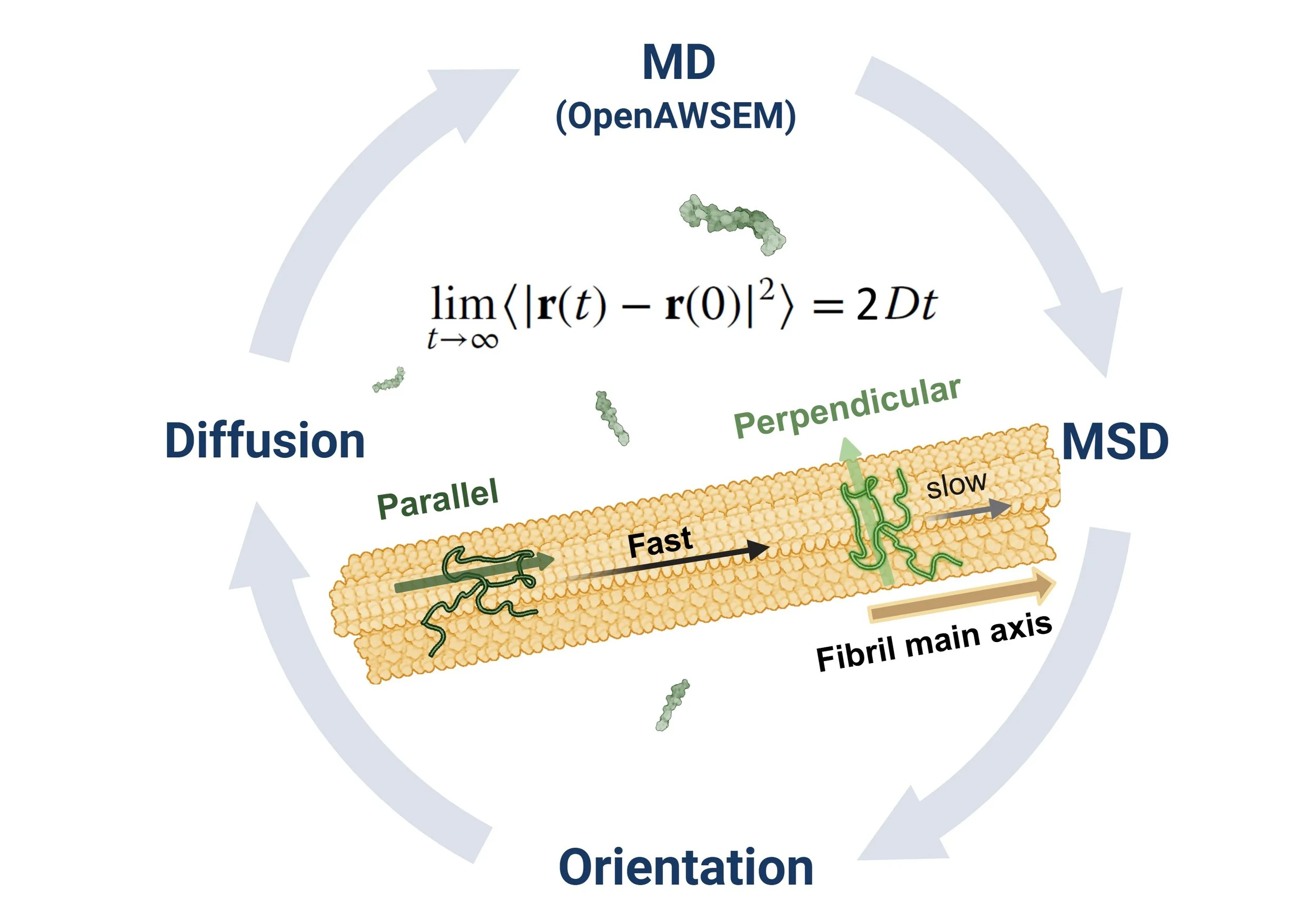
我們最新的研究 〈利用分子模擬探索 Abeta42 單體在纖維蛋白表面的擴散動力學〉,揭開了阿茲海默症研究中一個長久未解的謎團——β-類澱粉蛋白(Abeta)單體在纖維蛋白表面如何移動並組裝。

🔍 粗粒化分子動力學模擬的關鍵發現:
1️⃣ 方向很重要:沿纖維軸平行排列的單體擴散速度遠快於垂直排列的單體。
2️⃣ 表面質地也關鍵:平滑的纖維表面促進快速移動,粗糙的區域則會減慢擴散。
3️⃣ 隱藏的能量節奏:我們發現纖維表面存在週期性的能量地形,由其表面地形與單體物理尺寸共同塑造,像賽道上的軌道一樣引導單體的運動。
4️⃣ 纖維扭曲的調控作用:纖維固有的扭曲可選擇性地影響單體方向與擴散,進而影響纖維生長速率。

💡 為什麼重要?
這些發現將我們對纖維蛋白延伸的理解,拓展到傳統「端點延伸」模型之外。透過揭示分子方向性、表面異質性與能量地形的交互作用,我們提供了全新的理論觀點,並為開發延緩或抑制病理性聚集的精準治療策略帶來啟發。

🧪 這項工作連結了分子生物物理與治療策略,展現奈米尺度動態如何影響疾病進程。

🙏 特別感謝我的學生 王冠方(中正化生)、陳宏毅(中正化生)、馬元偉(清華生資) —— 你們的投入與洞察讓這項研究得以實現。看到你們在研究上的成長,讓我既欣慰又驕傲。

此工作發表於美國《蛋白質科學》期刊 (Protein Sci., https://onlinelibrary.wiley.com/doi/10.1002/pro.70131)

MYTLab computational work is accepted for publication in J. Phys. Chem. B! 本實驗室之計算模擬研究發表於美國化學學會之物理化學期刊!

Exciting news! Our international team, consisting of members from both the CCU and the UW teams and led by MYT, has had our work accepted for publication in The Journal of Physical Chemistry B (J. Phys. Chem. B, https://pubs.acs.org/doi/abs/10.1021/acs.jpcb.3c07938)! This marks my first research article since joining National Chung Cheng University (CCU).

Research often requires understanding biomolecular interactions and their structural characteristics. The Protein Data Bank (PDB) offers many such structures obtained through various methods. However, do these structures fully represent reality? For instance, structures from X-ray crystallography may differ from other experiments due to crystallization conditions.

Our recent study focused on cofilin, an actin-binding protein regulating the dynamics of the actomyosin network. It acts as a monomer to sever actin fibers or as an oligomer to aid in protein assembly. We found that cofilin dimers can take various configurations depending on how their cysteine residues form bonds under cellular oxidative stress. Molecular simulations showed stable configurations, including a symmetrical dimer that may precede active oligomer formation.

I'd like to extend my sincere gratitude to my collaborator, Prof. Margaret Cheung, a Scientist at Pacific Northwest National Laboratory and Affiliate Professor at the University of Washington, for her invaluable support throughout this endeavor. I also want to acknowledge the outstanding contributions of our two talented students, Chengxuan Li from UW and Tingyi Wei from CCU. Their dedication and hard work have truly made this collaboration a success! 🎉

恭喜由MYT領導的國際團隊(中正大學團隊和UW團隊!這項工作已經被美國化學學會《物理化學期刊B》(J. Phys. Chem. B, https://pubs.acs.org/doi/abs/10.1021/acs.jpcb.3c07938)接受發表!這是MYT加入國立中正大學後的第一篇研究論文。

研究生物分子相互作用的課題通常需要了解其結構特性,尤其是在使用電腦建立分子模型並模擬其運動軌跡時。這些模型需要參考實驗結構作為基礎,而蛋白質數據庫(PDB)中包含了許多通過X射線、核磁共振(NMR)和冷凍電子顯微鏡(cryoEM)等方法獲得的生物分子結構。但是,這些結構資訊是否完全反映了真實情況呢?例如,通過X射線結晶得到的分子結構可能在實驗條件上與其他生物活性實驗存在差異。

我們的研究團隊最近發現了這個問題的答案是否定的,並提出解釋。PDB上公開的生物分子結構資訊可能未必完全反映真實情況。我們的研究聚焦於一種名為絲切蛋白的肌動蛋白結合蛋白,它在細胞中調節肌動蛋白網絡的斷裂和組裝,其功能取決於其單體或寡聚體狀態。單體時,絲切蛋白能夠切斷肌動蛋白纖維並促進單體再循環,而在寡聚體形成時,則參與了肌動蛋白的核化和組裝,進而影響細胞骨架的組織和重塑。

我們的研究發現,絲切蛋白形成二聚體時,可透過不同的蛋白質結合介面形成多種組態,這取決於其半胱氨酸在細胞氧化壓力下與另一個絲切蛋白的半胱氨酸形成的雙硫鍵對。我們利用分子動力學模擬研究了這些二聚體的構型和穩定性,並發現了能量上穩定的結構,其中一個具有對稱性構造的二聚體可能是形成生物活性寡聚體(例如四聚體)的先驅物。

我要感謝我的合作者Margaret Cheung教授(太平洋西北國家實驗室的科學家、華盛頓大學的兼任教授),她給予了我很大的支持。這項工作由兩位優秀的學生Chengxuan Li(華盛頓大學物理系)和魏亭宜(中正大學化生系)合力完成。這是非常棒的研究工作!

Created with BioRender.com

MYTLab protein aggregation simulation work is accepted by Front. Mol. Biosci ! 本實驗室的蛋白質聚集研究工作已被接受,即將發表於Front. Mol. Biosci!


Congratulations to my undergrads, Jeff and Yoyo! They are about to publish their first research paper in an SCI journal (Front. Mol. Biosci.)! This work is my first independent work at TKU. The results are all done by my talented undergrads. I am so proud of you!

恭喜元偉與彤祐即將發表研究工作於SCI國際學術期刊 (Front. Mol. Biosci.)。此工作是來到淡江的第一篇獨立研究工作,是『全』淡江陣容!所有結果都是『專題生』完成的喔!真的以你們為榮!

fibril_surface_Jeff_Yoyo.png