
Can a protein change its fluorescence without changing its structure?
Excited to share our latest work published in Chemical Physics Letters!
Tryptophan fluorescence is widely used to probe protein structure and dynamics. Yet the molecular origin of its temperature dependence remains an intriguing question.
Using bovine serum albumin (BSA) as a model system, we found that increasing temperature induces a subtle redistribution of Trp134 rotamer populations, even while the overall protein structure remains largely intact.
By combining molecular dynamics, free-energy landscape analysis, quantum chemistry, and QM/MM calculations, we reveal how small changes in local conformational stability can influence experimentally observable fluorescence.
Three key insights from our study:
• A protein does not need to unfold to exhibit a temperature-dependent fluorescence response.
• Subtle changes in free-energy landscapes can redistribute molecular populations and influence measurable physical properties.
• The protein environment matters: isolated molecular energetics do not necessarily capture the behavior of a chromophore embedded within a complex biomolecular environment.
For me, the broader significance lies in connecting molecular dynamics and statistical thermodynamics with experimental observables.
Rather than treating proteins as static structures, we view them as dynamic ensembles whose populations continuously evolve across complex energy landscapes.
Sometimes, a small molecular motion can tell a much bigger story.
Congratulations to I-Shan, Yun-Chu, and Wei-Hsiang for their contributions to this work!
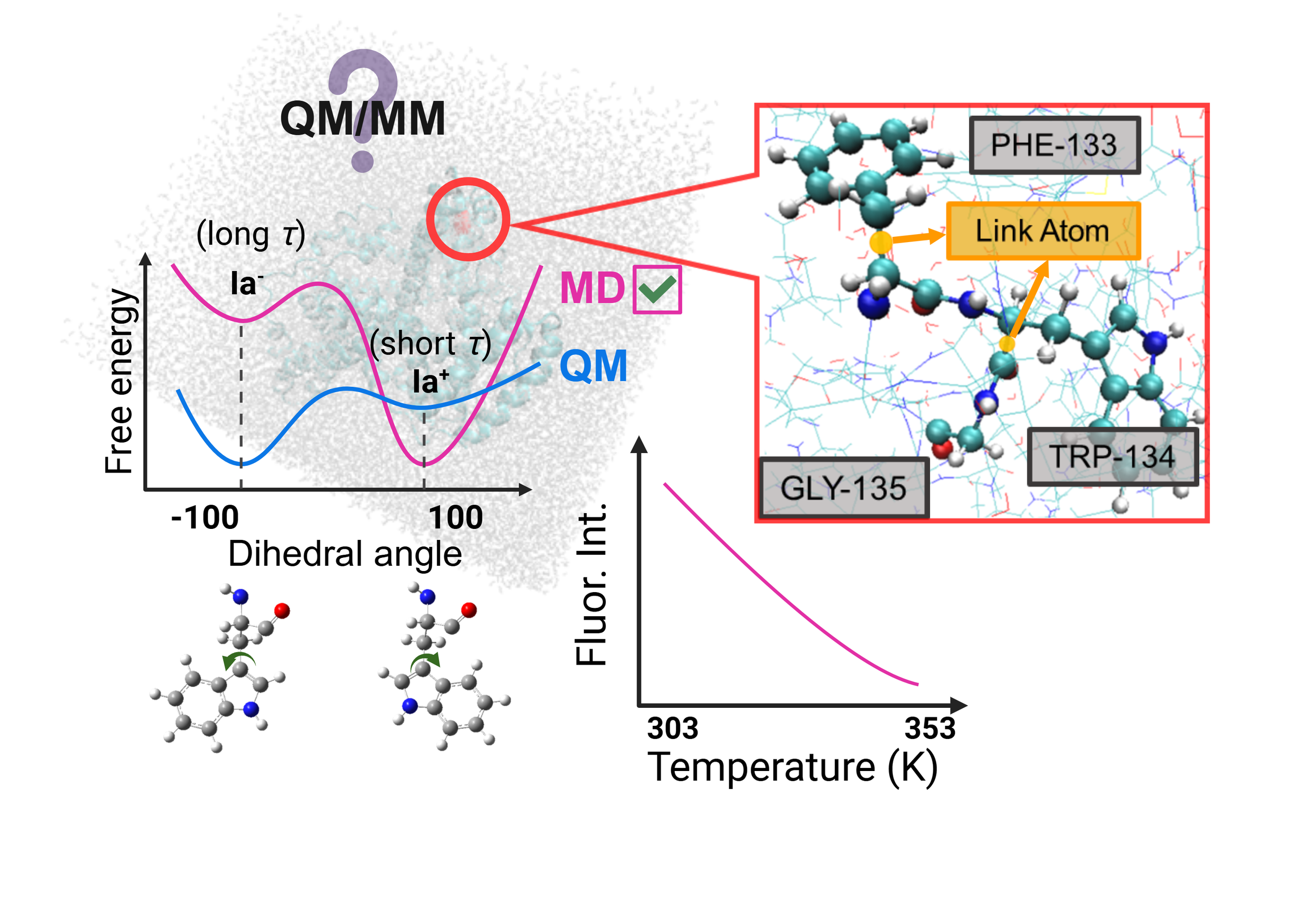
Temperature reshapes the rotamer free-energy landscape of Trp134, leading to population shifts that modulate intrinsic tryptophan fluorescence in proteins.
蛋白質沒有變形,螢光卻改變了?
很高興分享我們最新發表於 Chemical Physics Letters 的研究成果!
色胺酸(Tryptophan)螢光是研究蛋白質結構與動態的重要工具。然而,當溫度升高、螢光強度下降時,究竟是什麼分子機制造成這個變化?
我們以牛血清白蛋白(BSA)中的 Trp134 為研究對象,發現即使蛋白質整體結構維持穩定,色胺酸側鏈的旋轉異構物(Rotamers)仍會隨溫度升高而重新分布。
透過整合分子動力學(MD)、自由能地景分析、量子化學(QM)及 QM/MM 計算,我們從分子尺度建立構形動態與螢光訊號之間的物理連結。
這篇研究帶來三個重要啟示:
蛋白質不需要發生大規模結構變化,也能產生可量測的螢光響應。
自由能地景中的細微改變,可以透過分子構形族群的重新分配,影響實驗可觀測的物理性質。
分子所處的環境至關重要。孤立分子的能量特性,不一定能直接代表其在複雜蛋白質環境中的真實行為。
對我而言,這項研究更重要的意義,是如何將統計熱力學、分子動態與實驗觀測建立具有物理意義的連結。
我們不應只將蛋白質視為一個靜態的三維結構,而應將它理解為一個持續在複雜自由能地景中探索與重新分配的動態系綜。
有時候,一個微小的分子轉動,就能訴說一個更宏大的物理故事。
也恭喜苡珊、芸楚和葳翔,感謝大家在這項研究中的努力與貢獻!
📄 Temperature-dependent rotamer population shifts govern tryptophan fluorescence in proteins
Chemical Physics Letters 2026 899, 143025
https://doi.org/10.1016/j.cplett.2026.143025